Wednesday, December 06, 2006

Japanese Wedding Forecast?

Congratulations! Finally, you REACH my conclusion! I am showing you my script of the presentation, "Japanese Weddings from Traditional to Modern." If you are reading this article FIRST, I recommend you to go back to the "Japanese Wedding Ceremonies" section. This is the sequence of 6 articles. GOOD LUCK!

In conclusion, I would like to have a quiz. What percentage of Japanese newlyweds have argued while planning their weddings? What do you think? It is 87%. That’s a lot! Isn’t it!? Next, what percentage of them have thought “I am going to quit this marriage!” ? Actually, it is 45% Almost half of them! (Both results are from the Wedding Trend Research in 2005, by a Japanese wedding magazine, Zexy.) I was surprised at the result, and told my husband about that. He wasn't surprised, and said. “Yeah, I know, because I am one of them.” ...I hope he was kidding!

Anyway,Generally, the wedding is a girl’s dream. But for many grooms, it is tiring, expensive, and embarrassing! However, I think a young Japanese guy’s view of weddings has been changing recently. The wedding trend research in 2005 by Zexy says, 25% of the grooms went to beauty salons to have facial massages before their wedding days! Many young Japanese guys enjoy having weddings as their big events!

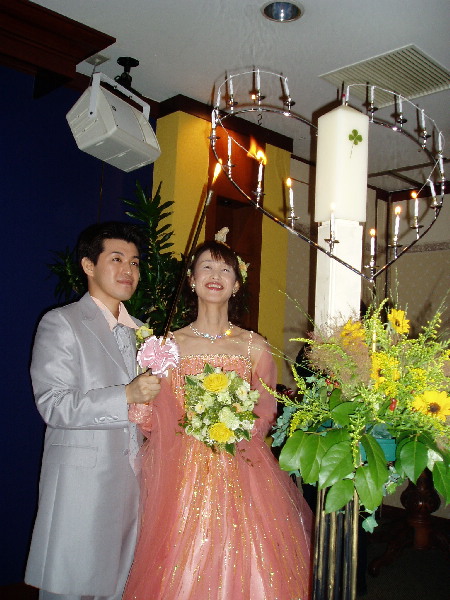
To have known this tendency, the biggest Japanese wedding planning company, the Take & Give. Needs have suggested, “You are celebrities!” concept. For example, after you registered your marriage at a city hall, a reporter and a cameraman had been waiting for you. They asked you a lot “How did you feel right after registering for the marriage? “or “ When did you decide you were getting married?” and so on, like "You are celebrities!"(The image is the right picture) Also, you can hold a conference to announce your engagement like "You are celebrities!" (The image is the left picture. These two pictures are from the Website of the Take & Give. Needs: http://www.tgn.co.jp/index.html ) Those scenes are recorded, and you and your guests can enjoy those videos during the reception.

I don’t know if this style will be a trend, but it can be because a wedding is not just a girl’s dream anymore, recently, it has also become boy’s dream!!!

...How was this presentation? Thank you for reading the looooong series!! Besides this script, I showed some videos showing modern wedding concepts well♪ What? I may have worked hard to research for this presentation, but you think the audience was also hard to listen to ALL of my talking? Yeah, I think so, but I have found another interesting things, so I wish I had TWO hours to talk about this topic!!!


Japanese Trendy Weddings

This is the FIFTH part of my presentation☆☆☆☆☆

Now, let’s do something fun! I will introduce you to five trendy wedding items. Let’s imagine you are a bride-to-be (or groom-to-be.) And, please vote for the one you want for your wedding! Let’s get started!

Welcome to Keiko's wedding planning office! Congratulations, you will get married! I will show you the Japanese trendiest wedding items. Which one do you like most?
(In advance, OF COURS these items are not my original!! All of items and pictures belong to the Take and Give. Needs, the Japanese Wedding Planning company. All of pictures, except for the picture of the bouquet toss, are from here: http://www.tgn.co.jp/index.html )

First, this is “the time capsule.” This capsule has to be opened ten years later. You can put anything in the capsule, like Polaroid photos of your wedding, letters to yourselves ten years later, and your future children. Or maybe your wedding day’s newspaper. During the ceremony or reception, you lock the capsule, and give the key to your dearest person like your parents, your aunt, or your close friend, someone you will keep company with at least ten years. Ten years later, he or she has to give the key back to to give the key back to you and then, you can finally open the time capsule!

Second is “the dream child!” Because of computer graphic technology, you can predict the faces of your children-to-be and you can show their faces to the guests during the reception! From the top, the right is you, the left is your groom, and below, they are your dream boy and your dream girl! (picture) Don’t worry, you can choose the details of your children’s faces! If you don’t like your husband’s thin eyes, you can put your eyes to their faces!


Third, “The Weight Dolls.” Instead of flowers, now this is the most popular presents to parents. These stuffed dolls’ weights are the same as you and your groom were when you were born. When your parents hold them, they remember how tiny you were and how you have grown up! I bet your mom would cry at this moment! You can choose “the weight mickey”, “the weight pooh”, or "the weight teddy bear!! "


This is the fourth. (The right picture) What do you think this is? This is broccoli. Have you ever heard of a bouquet toss? After the wedding ceremony, a bride tosses a bouquet to her friends who are single. (The bouquet toss's picture is from here: http://www.weddingvillage.jp/tachikawa/happy/vol2.html ) The one who catches the bouquet will get married next. This is a western traditional wedding event. But…it doesn’t have to be a bouquet and a girl! A bouquet and a broccoli sound similar. Don’t you think so? Therefore, you, the groom will toss a “broccoli bouquet” to your friends who are single! The one who catches this will be the next groom, and broccoli is good for his health, too!


This is the last one. (The left) What is it? Yes, this is a panel! This would be you and your groom’s picture and this is life-sized! Your guests can take a picture with your life-sized panel before a wedding reception starts!


So, please decide on just one for your wedding: a time capsule, dream child, weight bear, broccoli toss, or your life-sized panel. Have you decided?

I also asked my audience of my presentation. I think about two-third of them were Americans, and rest of them were from another contries. Which one do you think was the most popular? The answer was... The time capsule! From the most popular one to the least, the time capsule, weght dolls, broccoli toss, life-sized panel, and dream child. I thought the dream child would become the most popular one, but the reality was opposite! If I were a bride-to-be? I would take...let's see...broccoli toss! because it's funny, and cheapest♪


Comparison of a Traditional Japanese Wedding and a Modern Wedding


This is the FOURTH part of my presentation☆☆☆☆
Have you gotton tired?

Now, let’s compare a typical traditional wedding and a typical modern wedding. Here, “Traditional” means approximately from the 1970’s to the early 1990’s. “Modern” means from the late 1990’s to now. I think Japanese popular weddings have changed dramatically between the 20th century and 21st century.

Let’s take a look at a traditional wedding. Most couples celebrated their wedding ceremonies in a Shinto style or a Christian style.
Then, the reception began. The bride and groom entered in the wedding place with their wedding matchmaker (媒酌人)couple.
The matchmaker made a speech.
He also introduced the couple’s background. Where they were born, which schools they graduated from, and so on. On wedding occasions, most grooms were described perfectly; “He graduated with outstanding grades!”even though it was not true because a wedding was a very formal occasion. In many cases, the main guest was one of the groom’s bosses who made a speech.
Then, many couples chose the bride’s boss as the person who made a toast.
Finally guests could start to drink and eat. But the bride and groom exited the banquet room to change their clothes from Japanese Kinomos to a western tuxedo and a wedding gown.
They entered the room again, and cut a huge, tall, fake wedding cake. Some guests started performances, but, the bride had to exit there again to change her dress from a wedding gown to a colored evening dress.
After she finished, the bride and groom did a candle service. Other guests started to do some performances again.
At the finale of the reception, the bride read a letter to her parents to show appreciation. The couple gave bunches of flowers to their parents.
Last, the groom’s father and the groom made closing speeches.
This is a sample of traditional Japanese weddings.

Let’s go through a sample of modern weddings to compare.
Now, most couples celebrate Christian style wedding ceremonies or intimate ceremonies(人前式). Still, the Christian style is the most popular. However, the numbers of couples who choose an intimate style have increased in the past five years because many couples have started to think it would be weird to have religious weddings if they are not religious. I got married in 2001, and we also chose this style. I guess you may think it’s funny, but an intimate wedding can be held anywhere even a Shinto wedding room or a wedding chapel.

Let’s move on to the reception. The bride and groom enter the room alone. In 2005, couples who had wedding matchmakers were only 3%. Most of them don’t choose a wedding matchmaker system because one of their keywords is not official, but intimate.
The groom himself makes a welcome speech.
Lately, many couples introduce their backgrounds by themselves. The groom introduces the bride and the bride introduces the groom. Therefore, they can talk about themselves honestly. Some couples reveal that a groom failed to pass to the next grade when he was a student, or the bride didn’t like the groom when they met first time. They are trying to show themselves realistically. Another pattern is an emcee interviews the couple. The couple doesn’t know what they will be asked, so guests can enjoy natural responses from the couple.
Then, somebody makes a toast. Nowadays, sometimes the one is decided by a lottery. For example, if you find a seal under your glass, you have to make a toast! Many couples think prepared speeches are too formal. They like to have impromptu, and informal speeches now.
Also, they want to spend much time with their guests instead of changing clothes, so many brides don’t change their clothes or change just once. Instead of a candle service, the couple distributes small gifts like sweets and can talk more with every guest. Some couples take a photo at the each table. Some grooms serve beer by themselves carrying a big beer server like the first picture! Lately, to have their “original” beer label is getting popular, like the left picture. It is also nice to give guests their wedding beer as souvenirs.
After the couple enjoys the time with the guests, they cut a wedding cake. The modern wedding cakes are not fake, nor huge, but delicious, real cakes.
Recently, many newlyweds hesitate to ask guests to perform because they want guests just to be relaxed. Therefore, they try to entertain guests. Some newlyweds play musical instruments together. In my case, my husband and I asked guests what kinds of questions they had, and answered them. For example, what do you call each other when you are alone? Do you have anything you want your partner to correct? something like that. Also, our wedding day was my cousin’s 22nd birthday. So we had a surprise party for her. Some couples ask professionals to entertain guests. They hire some musicians, singers, or magicians.
Then, the interview from an emcee to guests instead of prepared speeches! This is also surprising for guests, but it’s fun! We can also have impromptu presentations by guests.
The reception is almost finished. The bride reads a letter to her parents. However, here is also one difference from the traditional one. Lately, some wedding planners ask the bride’s mothers to write a letter. It is a secret to the couples. When the bride’s mother reads a letter surprisingly, almost all brides start to cry.
After that, a couple presents something to their parents. Bunches of flowers are standard and nice. However.. plus something! Some couples write their original testimonials to parents like those right pictures, but the most popular gift is…I will tell you later.
At the end of the reception, not only the groom and groom’s father, but also the bride’s father and the bride herself give some short thank you speeches to the guests.
(All of pictures are from the Website of the Take and Give Need, the biggest wedding planning company in Japan.

http://www.tgn.co.jp/index.html This Website is marvelous! If you can read Japanese and be interested in, you should check it out!!)

I hope you have figured out how traditional weddings were formal, polite, and conservative, and how modern weddings are original, surprising, and intimate.

Next.. let's do something fun!!


Japanese Modern Weddings


This is the THIRD part of my presentation☆☆☆

I think the keywords of the Japanese modern weddings are original, surprising, and intimate. To make their dream weddings come true, two major basic elements have been changed. One is the wedding place. Hotels and wedding complexes(結婚式場) are still popular because they are convenient. However, if you go there on weekends, there are several brides and grooms celebrating weddings in different rooms, at the same time. If a guest sees other brides, the wedding doesn’t seem special. Therefore, nowadays, the popular wedding places are wedding halls (ハウスウエディング)and restaurants. A wedding hall has one chapel, one big banquet room, a pool, and nice garden. If you applied for a wedding hall, that hall is yours for a day. You and your guests never see other brides and grooms. Also, you can do anything in the hall! Some couples who want to have nice dinners at their favorite restaurants would choose restaurants. Nowadays, many famous restaurants have started wedding businesses.

The other major element is a person who is in charge of weddings. Traditionally, when a couple planned their weddings, they talked with a middle-aged lady who were in charge of “formal occasions” in hotels or wedding complexes. They were experienced and knew formal manners well(婚礼担当者), but they were not innovative, but like their mothers. However, now the newlyweds need someone like their friends! Have you ever seen the movie, “The Wedding Planner?” (The picture is from http://movies.yahoo.com/movie/1804318786/info ) It was released in 2001, starring Jeniffer Lopes. Think about her. Jeniffer encouraged brides like their friend, and suggested some fresh ideas. In Japan, the wedding planning business was getting popular from a few years before this movie.

Japanese Wedding History


This is the second part of my presentation☆☆

Let’s go through the history of Japanese weddings. Until the end of the 19th century, we didn’t have particular wedding styles. When a couple got married, the families, relatives, and neighbors got together at a bride or groom’s house, the couple announced their marriage, and they had an informal party. There was no formal ceremony, and the party was not organized. I think we can call it an “Intimate style(人前式)” wedding. The interesting thing is an intimate style wedding is now getting popular again in Japan, and many young people think this is the latest style when they compare it to the Shinto, Buddhist, or Christian styles. However, it was a very traditional Japanese wedding style.

The first influential Japanese wedding was the Taisho emperor’s wedding in 1900. At that time, he was a prince. The prince and princess went to a Shinto shrine wearing beautiful Kimonos, and celebrated their wedding. Many newspapers showed the pictures, and many Japanese were fascinated by their style.  Since the price's wedding, the Shinto style (神前式)wedding became popular.

However, in 1914, World War 1 started. In 1939, World War 2 began and in 1945, Japan lost the war. During the chaotic ages between the wars, people couldn’t afford to have formal weddings.

But, from the 1950’s to the 1970’s, the Japanese economy had been getting very strong. The economic growth rate increased more than10 % annually in this era. The Japanese life had been changing dramatically. In the 1950’s, many hotels started wedding businesses. They built wedding facilities like Shinto wedding rooms, banquet rooms, and advertised gorgeous weddings. Also, a wedding complex (結婚式場)style emerged. A wedding complex is like a small theme park of weddings. The first picture is the appearance of a wedding complex. (The first three pictures are from the Website of the biggest Japanese wedding complex company. http://www.nagasaki-heiankaku.jp/ ) A huge building. A wedding complex has a Japanese Shinto wedding room, a Buddhist wedding room, a chapel, and some banquet facilities that have different capacities. In some local areas, a wedding complex style is still popular because it is convenient! You can choose any style of ceremonies, and you don’t have to move to a reception place.


It might be funny to you that most wedding complex companies have funeral complexes(葬儀場). Because Japanese thought weddings and funerals were formal occasions, we thought they were in the same category. (冠婚葬祭) When I worked as a wedding emcee, one day, one guy came close to me and said, “You are very lucky to be “a wedding” emcee.” I asked “why?” and he answered, “Because I am a funeral emcee.” It is true, but nowadays, we think it is weird and an old-fashioned concept. Therefore, we insist we are involved in a “ wedding” business, not “weddings and funerals!”

Let’s go back to the history of Japanese weddings. The era of the 1950’s to 1970’s is called “ the period of high economic growth.”(高度成長期) I think the slogan of this era was “Keep up with the Joneses!” People tried to follow what their rich neighbors or friends were doing because they wanted to look rich or gorgeous. Before that, a wedding reception was informal and guests were families and relatives. However, it became more organized and the bigger a party became, the more guests arrived. Couples started to invite friends, their bosses, and colleagues. Actually, the groom’s boss had a significant role in the wedding in this era. He would be a “wedding matchmaker”(媒酌人) which is a Japanese characteristic of weddings. Originally, a matchmaker is the person who tries to find the right partner for someone else to marry. However, a Japanese wedding matchmaker doesn’t have to be the one who introduced a bride to a groom. He is a symbolic matchmaker. Here are some wedding matchmakers’ pictures. These wedding matchmaker's pictures are from http://kiharaminoru.jp/modules/blog/category/category-1/The first guy is a captain of this reception, so he works at the place, and is not a guest. The second guy is a wedding matchmaker, and he is the groom’s boss. This is a groom. This lady is the matchmaker’s wife. The bride follows the matchmaker’s wife.


Here is (the left one)a picture during the reception. The left one is the matchmaker. He is making a speech. The matchmaker is always beside the groom. She doesn’t appear in this picture, but the matchmaker’s wife is always beside the bride. As you can see, the matchmaker is very important, and outstanding in a wedding reception. Therefore, believe it or not, some business people say your official future would change depending on which boss you ask as your wedding matchmaker. Now, we have figured out Japanese weddings became very official in this era. In the 1960’s, couples started to ask professional emcees to organize their weddings because wedding receptions became ceremonial. It is funny to me that the pioneer of the Japanese emcee was...寿 太郎, whose name is translated "Celebrate Tom!"

From 1970’s to 1980’s, people preferred more gorgeous weddings. This (the right picture) is called a “candle service.” (This picture is from http://www.joho-kyoto.or.jp/~lions/naitou/p4.html ) The bride and groom hold a candle together and light the tables’ candle, and then, they light a big, gorgeous main candle. (The left picture is from http://www.ne.jp/asahi/tsuru/kendo/2003-0720-11.jpg)They cut the wedding cake together as a ceremony. ( This picture is from http://sergeant.main.jp/ ) The cake had to be very tall, and big enough that every guest could see. But those wedding cakes were fake cakes because real cakes couldn’t stand this height. Some couples appeared riding in a gondola from the ceiling, and some of them appeared from the dry ice. I heard an American guest said, “A Japanese wedding is like a Las Vegas show.”


In this era. Especially, they paid much for the brides’ costumes. The typical bride celebrated her wedding ceremony in the Shinto style with a white Kimono(like the first left picture in the row is from http://www.matsui-studio.com/konrei/konrei.htm )and she appeared at her reception wearing a colored Kimono( The middle picture under the row is from http://homepage2.nifty.com/takahiro-masumi/maedori.htm. )But during the reception, she changed her costume twice to wear a wedding gown and a colored evening dress. (The right picture in the row is from http://www.center.nitech.ac.jp/~kenji/Diary/020428-wedding/photo.html The left picture under the row is from http://stevie.ti-da.net/e767771.html)

Actually, this style

of wedding still remains in some areas. I had been to this traditional type of weddings in my hometown, Sapporo before I got married. I usually did some performances like singing a song, or a short play with my friends. However, the brides never saw our performances because they were very busy changing their clothes!

In 1981, one worldwide celebrity got married. She was Princess Diana, in England.  (Her picture is from http://chiba.cool.ne.jp/koichi76/subj16.htm ) She was very popular in Japan. After her wedding was broadcast, many Japanese girls contacted domestic and international churches to ask if they could celebrate their weddings like Diana’s style. Before one year, in 1980, A Japanese true star in the era, Momoe Yamaguchi, a singer, got married to Tomokazu Miura, a famous actor, as a Christian style. (Her picture is left. It is from http://plaza.rakuten.co.jp/vegatta/ ) Many hotels and wedding complexes started to have “wedding chapels” in this era. This Christian style ceremony has become the most popular one even now instead of the Shinto style.


Let’s review the traditional Japanese weddings until the 1980’s. I would say, the keywords of traditional weddings are formal, polite, and conservative. The couples invited many guests including their bosses, so they had to be polite, and the wedding was considered as a very formal occasion. Also, many people followed the routine wedding styles by having matchmakers, wedding cakes, and candle services. Everybody could expect what would happen next. In addition, most couples took ceremony styles such as the Shinto style or Christian style not because of their religion, but their preferences.


In the 1990’s, the Japanese economy worsened. Before that, the Japanese economy was called “the bubble economy.” Literally, the bubble burst. The estate value decreased, and many business people’s salaries were frozen. People started to wonder why we had to pay so much money for weddings. Therefore, the “simplest wedding” came to be noticed. It means a newlywed registered their marriage, but they didn’t have a special ceremony and reception. However, it is always a girl’s dream to wear a wedding gown. Also, most parents dream of their daughters’ most beautiful event. But, no more old formal styles! From the late 1990’s, young people started to seek their “original” weddings. Now, let’s move on to the Japanese modern weddings! Are you ready? My presentation goes on FOREVER!!!


Japanese Wedding Ceremonies


This is the first part of my presentation☆

Let's take a look at what kinds of wedding ceremonies Japanese have had. There are Shinto(神前式), Buddhist(仏前式), Christian, and Intimate(人前式) styles.
First, the Shinto style ceremony. Have you ever heard of Shinto(神道)? Shinto is the ancient religion of Japan. Our ancestors believed there are many gods in the world, not only one. When I was a child, my grandmother told me, “You will be scolded by a nature-god if you spoil the flowers.” Or “You will be punished by a fertility god if you leave your food.” and so on. In Shinto, two gods gave birth to the Japanese islands. If people celebrate a Shinto wedding, they go to a Shinto shrine, and swear their love to the two gods who created Japan.

I will explain what is the Shinto wedding is like briefly.  A bride wearing a white Kimono(like the picture) and A groom wearing the black Kimono go to a Shinto shire. They ride an ancient-typed taxi pulled by a person(人力車). The families follow the couple. Just close families participate in a Shinto wedding because a Shinto wedding room is not so big. In the ceremony, a Shinto minister purifies the couple and he announces their marriage to the gods. The bride and groom drink Sake, an alcohol drink from the same cup, instead of kissing. The groom makes a vow. They hold holy branches to swear their eternal love to Japanese gods. At last, the whole family drinks sake to promise they will become one family. This is a Shinto style wedding which was very trendy in the early 20th century. (This picture is from the Website of Okayama Kokusai Hotel: http://www.oih.co.jp/wedding.html )

The Buddhist style is celebrated in a Buddhist temple to announce their marriage to Buddha and the couple’s ancestors because in some temples, they have buried their believers. I think you know well about the Christian style weddings. Last, “the Intimate style wedding” is not related to religion. Couples swear their eternal love, not to a god, but to their families and friends, intimate people.

Now, I think I should explain about the relationship of the Japanese and religion. A wedding is a big event of a personal life, so many people celebrate their weddings based on their religion. So, which religion do the Japanese have? There is no formal record, but one private survey says, “45% of the Japanese believe in Shinto: 49% are Buddhist: 1% are Christian: The other 5% believe in other religions.” However, I am not sure this survey is correct because many Japanese don’t think they are religious, including me. A typical Japanese pattern is like this. When she was a child, she was celebrated at a particular age like one, three, seven, at a Shinto shrine. But she celebrates her wedding as the Christian style. And when she dies, her funeral is organized as the Buddhist style. Many Japanese have a Buddhist altar and a Shinto altar in their home, as well as my parents. I am not a specialist of religion, so please don’t ask deep questions about that. However, in my personal opinion, many Japanese cherish our ancestors’ customs and morals instead of religion. So, the popular Japanese wedding ceremony styles have been changed by trends and life styles in the era, and some celebrities’ weddings .

Tuesday, December 05, 2006

"Japanese Weddings from Traditional to Modern"


Sorry guys, it's been a long time to see you! On November 27th, I made a one-hour presentation. The title was "Japanese Weddings from Traditional to Modern." Yes, it is my main interest & profession! But, it was not so easy to explain what the Japanese wedding was like to Americans. Therefore, I have buried myself in the research about the Japanese wedding history and the Japanese wedding trends. Eventually, it was...REALLY FUN!! I just forgot the time when I prepared for this presentation!

My audience was the members of the International Friendship Group. It is a part of the Purdue Women's Club. Pudue is the university in our town. There are many ladies who are students, students' wives, professors, professors' wives, in this club. The members of the International Friendship Group have a meeting once a month to learn about many countries' cultures because Purdue has such a diversity of nationalities!
My tutor, Sallly, is a co-chair of this group. She suggested I make a presentation about Japanese weddings there. I was pleased to accept the offer! It was great to have such a wonderful opportunity!

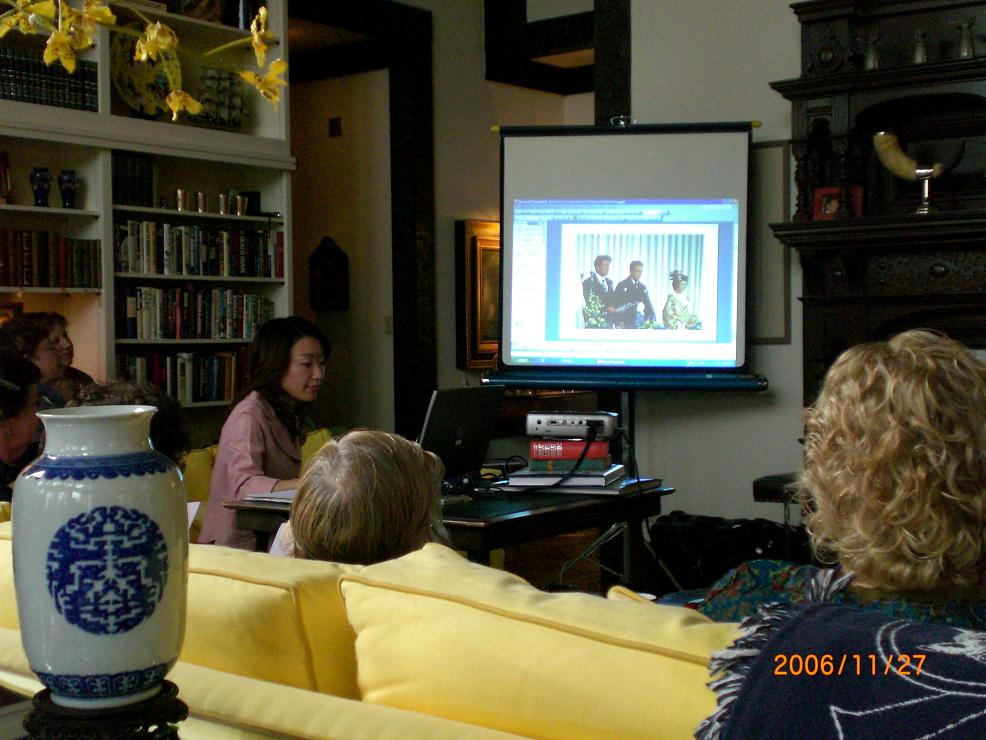
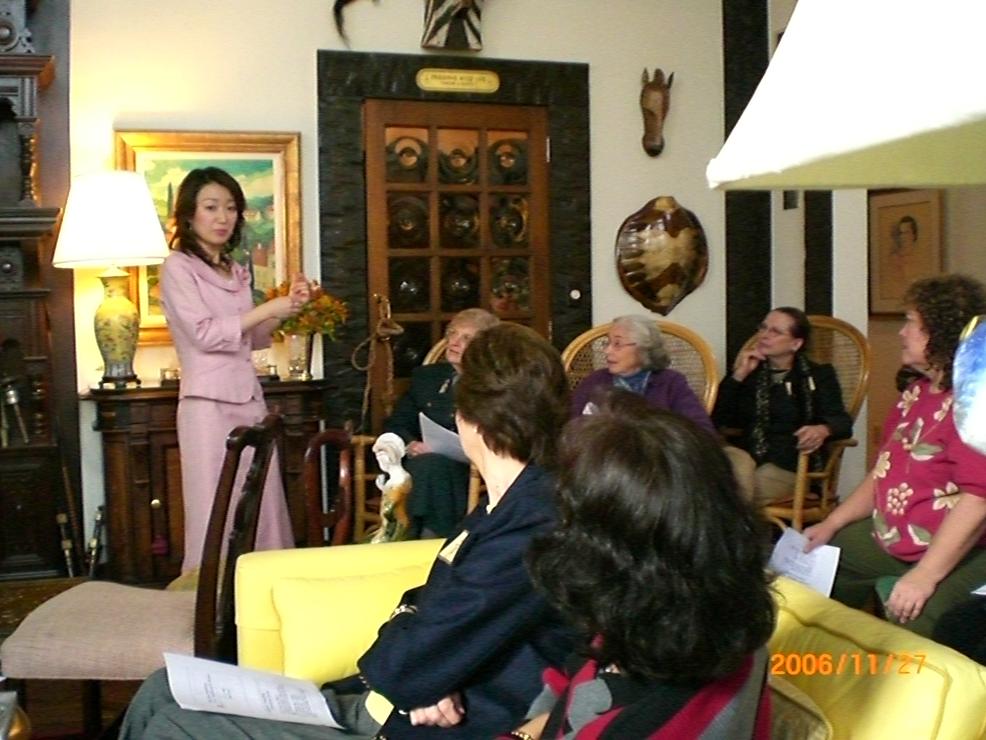
Last month, the meeting place was Mrs. Fran's house which was located beside my hubby's favorite golf course. On Monday morning, we had nice refreshments that some members prepared. The first picture is before the presentation. The ladies were relaxed☆ Even though Americans like to use plastic or papar cups & plates, in this group's meetings, we have never used those. They can provide nice china tea cups & plates for all members!

My audience was almost 60 people. I was afraid of my voice condition. I didn't have a microphone. This was a private house, so, the acoustics were not so good. Also, some members had hearing problems. But I had to convey my message to 60 people for one hour!
However, as a result, my presentation was successful♪ Many people, including ladies who had hearing problems, said my talk was very clear and easy to understand. They also said that my visual aids were great. I prepared handouts, Power Point slides, many photos, and some videos. But, what made me most happy was everybody(maybe) enjoyed my presentation! One lady said, " This is definitely one of my favorite presentations!" Another lady said, "You should do this presentation at other places. I have no idea where...but keep all of your materials!" Another lady said, " Every woman all over the world loves weddings. So, your topic is very suitable for our ladies' club!"

However, of course I know I have some things to improve! After I came back home, I listened to the tape I recorded. My voice was big enough, but it would have been better if I had spoken softer, sometimes. Also, I noticed I had done a weird response. When I asked a question to my audience, one lady said, "Eighty-seven percent?" It was the right answer. But I am not good at numbers, so I responded, "Eighty-seven? Oh, it's close! Actually, the answer is...eighty-seven." I caught what the lady said, but I imagined eighty-three. I don't know why... I didn't notice at the actual presentation, but it was like a short comedy skit! It sounded silly...I am sorry for the lady who gave me the right answer!

My tutor, Sally, said, I spoke fast when I introduced the Japanese trendy wedding items and had a quiz. I know why...because I wanted to present them cheerfully and lively! I didn't provide handouts of these parts because they were an impromptu survey & a quiz. Therefore, if I spoke fast, it was hard for the audience to understand. Especially, I mispronounced some words, like "argue" and "panel," so, people who couldn't read my slides had difficult understanding, as Sally said.

Sally is such a nice lady that she said, "Keiko, don't be discouraged. I tried to offer suggestions, but overall, you did a fantastic job!" Thank you! I wasn't discouraged at all! It is great to have some observations from major presentations! Whenever I make a speech at the Toastmasters' meetings, every member evaluates me. Those also are precious opinions for me!

I will publish my script of this presentation soon. See you soon, I promise!